Research
The Method 2/7 - Getting a Yes
Getting a Yes
How do you turn a target into a participant in your study?
In part one we followed the clues: the murder board, the map of the network, the signal in the noise, the snowball gathering pace. By the end we had a research board full of names.
But there's a gap between a name on the board and a person giving us an hour of their day for a depth interview, and right now that gap is widening. Unread email counts run into the thousands. Call logs read “Suspected Spam” from top to bottom. And a growing share of the messages people do open were written by a machine, in the same cadence, with the same cheerful opener, asking for the same fifteen minutes. AI-written outreach seems to be deadening the senses of already tired readers. People have learned to skim for that rhythm and delete.
So the second part of our methodology is about the approach: how we go from a network mapped to interviews booked, and how we give the people we’ve discovered a reason to say yes.
It’s the stage where we begin building relationships. A good search can be done alone at a desk. Getting a yes means stepping into someone’s world, knocking on the door, and asking to be let in.
Here’s how we get more doors to open.
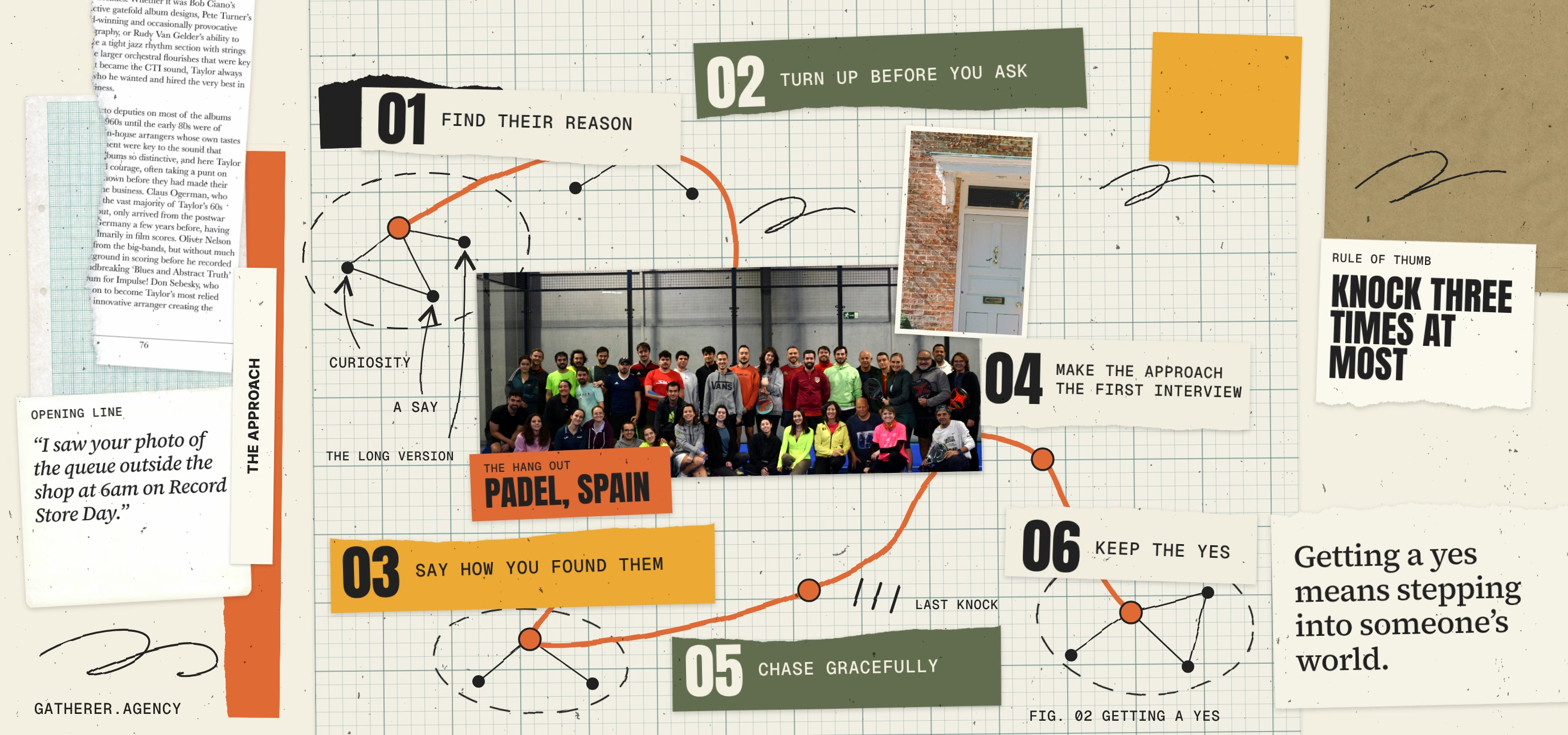
1. Find their reason
Start with the obvious question. Why would this person, with their heaving inbox and chock-a-block diary, choose to talk to us?
In our experience, there are three prevalent reasons:
People say yes out of curiosity: about the project, about who’s asking, about why on earth a research agency is interested in robot lawnmowers or open-water swimming. The people we speak to are often as curious about the picture we’re assembling as we are about their piece of it, so we share what we’re free to share …
They say yes for the chance to have a say in something they care about.
And they say yes to talk at length about something they’re interested in, or even passionate about. Most of us have a subject our families have heard quite enough about, and an hour with someone who wants to hear the long version is hard to turn down!
So before we write a word, we work out which of these might matter most to this particular person, and we put it in the first line:
“I wanted to get in touch because your name has come up three times now in conversations about the local HYROX scene. I’m working with the founder of a new type of HYROX training machine, and I’m hoping to find out what you make of it before it launches.”
“I saw your photo of the queue outside the shop at 6am on Record Store Day. We’re researching what record shops mean to their regulars, and I’d love to hear about your morning.”
“I was at the supporters’ trust meeting on Thursday when you asked about the new ticketing scheme. We’re researching how fans feel about the changes at the club, and I’d like to hear the rest of what you had to say.”
Each one is written for the person, around the reason we think they’d say yes. If we can’t write a line like that yet, we probably haven’t finished the search.
2. Turn up before you ask
Getting a yes is easier when you have immersed yourself in the world of your subject. Here we borrow from anthropologists and ethnographic researchers, with an “ethnography lite” version of the deep hang out.
Clifford Geertz used the phrase “deep hanging out” for the first stage of anthropological fieldwork, and he meant the long, local, vernacular fieldwork that takes years. Ours takes a few weekends. But the principle remains, as does much of the understanding it produces. It means paying attention, and leaving the clipboard at home.
We practised in Spain this summer, for a study on padel culture. Over three weeks of travelling we spent as much time as we could in padel clubs, watching, joining in, and talking to whoever was around. There was no discussion guide. By the end, the questions we’d brought with us looked like a tourist’s questions, and we’d replaced them with a new angle. Padel is booming in the UK and the courts are going up quickly, but a court is the easy part. Spain has what sits around it: the social life, the local, regional, and national communities, and the competitive infrastructure that keep people playing for years. So what can the UK learn from Spanish padel culture while it is still building?
This kind of research has an online form too, and Star Trek fans are the reason it exists! In 1995 a marketing professor, Robert Kozinets, wanted to understand their online discussions, and the result was netnography, ethnography reworked for online communities. The Reddit lurking we confessed to in part one is the amateur’s name for it.
What comes back from all this, on foot or online, is what ethnographer Tricia Wang calls thick data. Numbers are easy to analyse because the context has been stripped out of them. Thick data is that context - the stories and feelings behind the numbers. You have to go and find it yourself. It gives us two things. The first is knowledge. We learn what to ask. We also learn which questions would show we hadn’t been paying attention. The second is empathy. In person, people are far more likely to engage. It’s easier to ignore an email. And the fact we turned up, spent time in their community, and learned the vernacular earns us “yes” points.
3. Say how you found them
The first question a person asks, aloud or in their head, is “how did you get my details?” Answer this before they ask…
This is where ethics and law overlap. Gatherer abides by the MRS Code of Conduct, and the Code makes it clear that building a research board is itself the collection of personal data: the moment a name from Reddit, Strava or LinkedIn is written down, it needs a lawful basis (Rule 27), it should be limited to what’s relevant to the project, and the source must be revealed to the person at an appropriate point. Where a client supplied the names the client should be named too.
Compare the AI-powered alternative described in part one. The audience-modelling platforms that profile people from their browsing data are precisely the “systematic and extensive profiling” that would trigger a formal data protection impact assessment. Mapping a network by hand, based on what people have posted under their own names, is slower, but it is still collecting personal data, which is why the rules above apply to us too. But it is a method we can describe to the person we’re contacting without embarrassment. Look back at the three opening gambits in section one: each says where we found the person before it asks for anything.
The same honesty applies to the invitation itself. The Code says people must not be misled when asked to take part, and must be able to check, without difficulty, who is approaching them. It also draws a line we find helpful: an invitation that uses promotional language about a client counts as direct marketing, with its own legal regime. So our approach describes the project. It never sells the brand behind it.
4. Make the approach the first interview
We’ve come to think of the approach as the first interview. It’s our chance to show we’ve done our homework and explain why we want to speak to this person in particular.
The MRS Code of Conduct settles something we used to treat as a matter of choice: how much to send in advance. The Code stipulates that before the activity proceeds, a participant must know who is responsible for it, what it’s about and why, what kind of data is being collected, that they can withdraw if they wish, whether it’s being recorded or observed, who will have access, roughly how long it will take, and that the work follows the Code and data protection law (Rule 30). Recording, in particular, must be disclosed at recruitment, rather than sprung at the start of the interview.
None of this forbids an unscripted conversation; we still prefer to arrive without a questionnaire. The logistics and the permissions travel ahead with the invitation, and the questions wait for the day. People are, in our experience, more candid when the boring parts have been handled properly beforehand. They know what they’ve agreed to, so they can relax into it. Send the boring parts first, and save the interesting ones for the interview.
5. Chase gracefully
Then there’s the silence. First approaches, particularly “cold” ones, often get no reply, and the question is how many times to knock.
The Code doesn’t set a number. What it sets are guidelines: no calls or messages to mobiles before 9am on weekdays and Saturdays, before 10am on Sundays, or after 9pm, unless the person has agreed to it; no pressure on anyone to take part, with extra care around anyone who might be vulnerable.
The worlds we work in tend to be small and well-networked. A pestered music conductor or padel coach tells others, and word spreads. So our rule of thumb is two follow-ups, each adding something new. The second chase says it’s the last, and where to find us if the timing changes. A non-reply is an answer, for now. More than once, this strategy has brought a reply two or three months later, when the timing suited them better. Knock three times at most, and leave a card on the last knock!
6. Keep the yes
A yes is a beginning. The experience that follows has to confirm that the person made the right decision.
Sometimes what they get is more than a good conversation. On one recent project, two of the people we interviewed went on to work with the client directly, one testing the product and one as a paid consultant, both introduced with their agreement. That won’t happen on every assignment. A proper thank you, and some feedback on what their contribution went on to inform, should happen every time.
Two things the Code adds here are easy to miss. First, the relationships that continue after an assignment, which we celebrated in part one, are a joy, but going back to a past participant for a new project needs the original permission to have covered re-contact. We ask for it at the time. Second, the snowball. Asking who else we should speak to works because the introduction arrives carrying a name the next person already trusts. But a participant’s details don’t get passed to a client without their consent. The map grows; the trust that built it has to hold.
Conclusion
Finding people, as we said in part one, is detective work. Getting a yes is what happens on the doorstep: who we are, how we found them, and why we think they’d want to talk, said plainly enough that the door stays open. Done badly, it’s one more message in the familiar rhythm, skimmed and deleted. Done well, it’s the first interview, and the conversation has begun before anyone sits down.
The research board is full of names. The job now is to earn each one. Part three, on the interview itself, picks up once we’re through the door ...
Next insight
The Method 2/7 - Getting a Yes
Inboxes are full and call logs read “Suspected Spam”. So how do you get a yes? In part two of the Gatherer method, we explore the approach: finding their reason, turning up before you ask, and saying how you found them.
Next insight
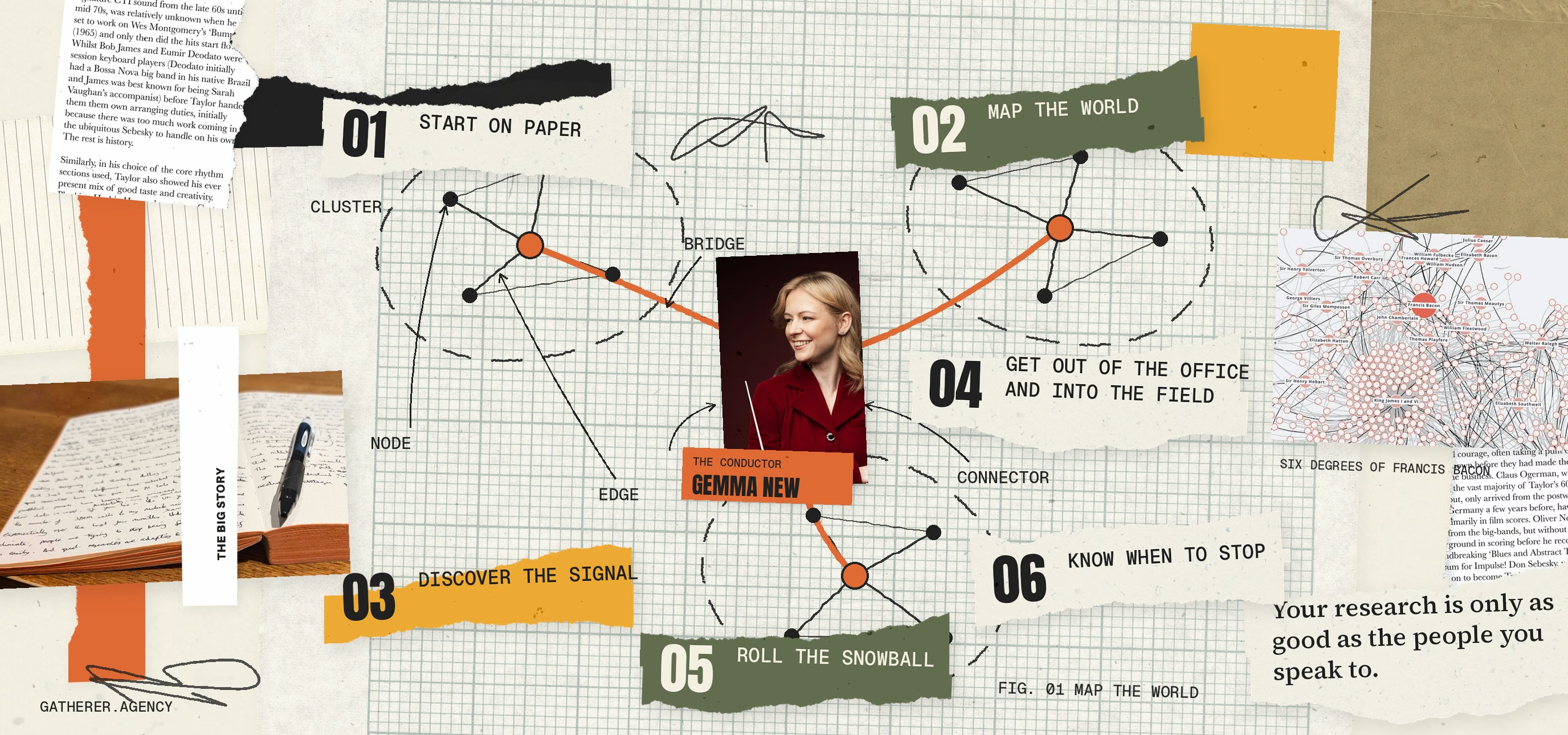
The Method 1/7 - Finding the Right People
Your research is only as good as the people you speak to. So how do you find them? In the first of our series on the Gatherer method, we explore the search itself: mapping networks, following clues, getting out into the field, and knowing when you’ve heard enough.
Next insight
Research as a creative advantage
Working as Polar’s qualitative insight partner, Gatherer brings first-hand evidence into new-business and live creative briefs. Across travel, yachting, sport, workwear, powersports, and beyond, our research has revealed new commercial opportunities, strengthened strategic thinking, and provided the insights behind big branding and creative ideas.

What are
you curious
about?
Tell us what you’re trying to understand, the decision you’re facing, or whose world you need to get closer to. We’ll take it from there.