Research
The Method 1/7 - Finding the Right People
Finding the Right People
In our world your research is only as good as the people you speak to. So finding the right people is crucial. And no two searches are ever the same, so each assignment demands a new search strategy. There are, however, some fundamental principles and universal techniques that guide our research methodology at Gatherer. And right now it’s an interesting time to re-examine them, because we’re adjusting to a landscape in flux: new technologies, new regulations, new attitudes and behaviours on and offline.
The onslaught of AI has triggered a renewed interest in qualitative research among our client base, with face-to-face conversations providing fresh and exclusive insights while offering the much heralded “human touch” that many strategists have identified as the antidote to AI oversaturation. The sea of slop on every feed, the AI poster on every wall, the patterns of writing, designing, and thinking that seem to be dulling our collective mind. At a time when businesses and brands are all relying on the same AI models for their strategy and data analysis, speaking to your people is a superpower. It grounds you. It reminds you of what we’re doing this for. And it provides wildly different answers to Claude and ChatGPT. Some of the best laid plans in boardrooms and AI chats fall at the first hurdle because no one consulted the actual people they were designed for. The complex, unpredictable, human people that we all want to speak to, entertain, and sell to. So, how do we find them?
The promise and pitfalls of AI-powered research
New AI models could be exceptionally powerful tools for researchers. Audience modelling platforms can use cookies and a wide array of browsing data and signals to understand who you are, what you’re interested in, what communities and networks you belong to, and what target lists you could be added to. Then it can scrape every bit of available personal data, and provide the researcher, headhunter, or malevolent scammer everything they need to contact you.
And keep contacting you, again and again. My call log is full of “Suspected Spam” numbers, and people across the country are reporting an increase in scam calls. Meanwhile, the UK is experiencing four "nationally significant" cyber attacks every week, with the number of major attacks having more than doubled this year. The major multiplying factor here is AI, and the exponential increase in AI-enabled research power that can be harnessed by both legitimate and illegitimate actors. Understandably in this climate, people are more sensitive than ever about privacy and how their data is being used.
Unchecked AI-powered research is dangerous. Not only does it endanger the privacy and even security of our target contacts, it also skips a series of vital steps on the typical assignment journey of a researcher. Immersion in your target world. The dead ends and rabbit holes. The unexpected encounters. The wild tangents that eventually unearth gold. Your unique path through the field, which enables you to understand the essence of the story, then reinterpret and retell it for creative and strategic breakthroughs.
So we returned to tried and tested research techniques, honed in the arenas of headhunting, academia, and commercial research in the creative and media spheres. Each of these industries share a dependence on finding the right people. You’re looking in different places for different things: on LinkedIn, job pages, and careers databases for professional talent; in archives for historical records to retrace events, networks, and experiences; or on digital channels and offline spaces for commercially valuable insights. But the fundamentals remain the same.
Becoming a detective
The key fundamental is a particular temperament or character trait: a natural curiosity and inquisitiveness. A drive to follow the clues and pull on each thread to see where it leads. To look up a term when you come across it for the first time. To spend time probing the background context before jumping in. To explore a tangent that might lead nowhere, but might lead somewhere (!), and, either way, will deepen your understanding of the overall picture.
It’s this temperament that makes the life of a qualitative researcher feel a bit like being a detective. And it’s what makes it so rewarding. From a personal perspective, I’ve always found the figure of the detective-as-hero deeply enchanting, from Sherlock and Poirot to Ludwig and The Thursday Murder Club. And although market research doesn’t always have quite such a glamorous reputation – many still picture being sat in a village hall box-ticking a survey about washing machines for £5 + a soggy sausage roll – a Gatherer search feels much more exciting, combining timeless strategies with next-gen approaches to offer something different to the creative insights world today. Although every assignment is unique, here are some fixed points along every Gatherer research journey.
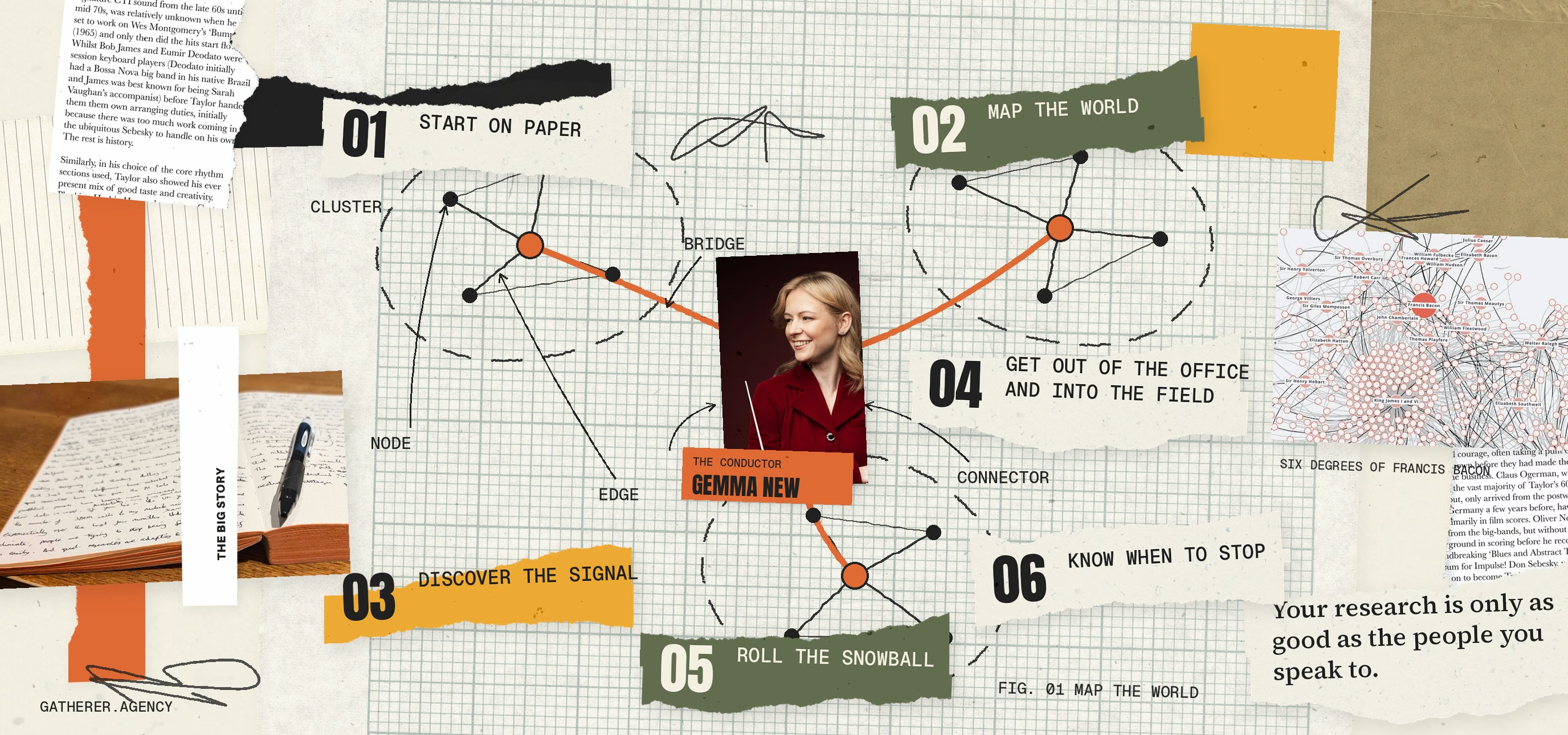
1. Start on paper
What’s the problem we need to solve with this search? Where do we begin, where will our journey take us, and what’s the end point? Who do we need to talk to, and why?
In the spirit of our emphasis on human conversations, we try to prioritise tangible, material processes and crafts, and starting on paper has so far proved the best way to achieve greater independence and clarity. The same with writing, including the writing of this essay! We’ve found that if you start with an AI draft, it’s very difficult to break out of the formulaic rhythms and structures that it initially lays down. And the foundations shape everything that comes next.
So we sharpen our pencils to write out our briefing notes, interrogate our prior assumptions, frame and reframe the key questions, and develop a search strategy on paper that will eventually resemble Rust Cohle's murder board in True Detective.
2. Map the world
Pencils and paper at the ready, but what should you actually start writing or drawing? A map! More precisely, a map of your target audience’s network.
Every audience lives inside a network. And although networks can seem amorphous, plotting the people and their connections reveals a chartable world, with a shape you can actually see. Projects like Mapping the Republic of Letters, Six Degrees of Francis Bacon, and Kindred Britain make this wonderfully clear, turning correspondence and connections into network visualisations – beautiful maps of interconnected worlds. Network theory helps us make sense of the constituent parts: the people (nodes), the relationships between them (edges), and the clusters that form around clubs, forums, events, and institutions. Some people connect these clusters, carrying information from one to another. Finding these bridges and connectors early can save weeks of searching.
So we map first. We chart the real world and the digital one: who the connectors are, where they gather, what rhythms the year follows, and who influences whom. The map at the beginning of this essay previews a more extensive version we created to plot the touring career of New Zealand conductor Gemma New, following a successful series of performances at Snape Maltings. It shows the kind of mapping we do for any research assignment, from orchestras to open-water swimmers: institutions, venues, partner organisations, and the links between them, with the gaps clearly marked for further exploration.
3. Discover the signal
Once you’ve started mapping a world, you need to find out where its conversations are happening.
We often begin on Reddit, where people gather around shared interests to swap recommendations, compare experiences, and tell strangers in detail why their new purchase has ruined their life! It’s a useful place to look for authentic social proof: the reviews, disagreements, and unsolicited advice that help people decide what to trust. In contrast to paid ads or public social media platforms, Reddit often feels unguarded and intimate, providing a more documentary-style snapshot of an online community.
Of course, an anonymous comment is still an anonymous comment. We follow the clues, look for recurring experiences, and check what we’re hearing elsewhere. Who offers advice that others take seriously? Which names keep coming up? What are people arguing about, and what do they seem to take for granted? Alongside potential interviewees, you begin to find the language and concerns that will help you ask better questions when you speak to them.
The most useful platform depends on the audience. LinkedIn can be the primary home of a professional network; other communities reveal far more of themselves on Instagram or TikTok. For a recent sporting assignment, Strava and YouTube proved crucial, leading us to find and speak to a leading influencer in the world we were exploring. You have to follow the audience into the places where it actually spends its time. Then get ready to observe and listen – or, in Reddit terms, lurk!
4. Get out of the office and into the field
Then there’s the world beyond the browser...
We describe Gatherer as a nomad agency because getting out into the field is fundamental to how we work. Meeting people where they are helps us understand the circumstances behind their answers, and notice things we wouldn’t have thought to ask about from our desks.
A recent study on robot lawnmowers brought this home. Responses varied widely between regions and countries, and even more markedly between generations. Reaching Gen Z meant looking in different places from those where we found Baby Boomers and Gen X. An audience that looks reasonably coherent in a brief can turn out to contain several quite different worlds. You only begin to appreciate those differences by spending time in them.
There’s something hard to beat about an in-person interview. The conversation before the conversation. The expressions and gestures that add meaning to an answer. The trust that develops when someone feels you’ve made the effort to come and listen. These encounters can lead to deeper conversations and relationships that continue long after the assignment is complete.
But meeting people where they are also means recognising where they feel comfortable. Some people open up more on a video call, with the familiarity of their own surroundings and a little distance from the interviewer. And geography, diaries, and budgets have a say too. Roughly half of our interviews take place in person, and half on video calls. That balance enables us to work worldwide while keeping the conversations personal.
5. Roll the snowball
Once you’ve found a few of the right people, ask who else you should speak to.
The bridges and connectors on your map are a good place to start: people whose relationships extend into parts of the network you haven’t reached yet. In qualitative research this is often known as snowball sampling, and it will be familiar to anyone who has worked in headhunting. One conversation leads to an introduction, which leads to another conversation, and your search begins to gather momentum.
This becomes especially valuable when the audience is small, private, or difficult to reach. On a recent search involving ultra-high-net-worth individuals, we found a way in through their spouses, who belonged to a social network at a premium membership organisation. The map helped us look beyond the obvious routes. Referrals then gave us access to people we would have struggled to reach cold.
Every interview can leave you with something to follow up: a name, an organisation, a gathering you hadn’t heard of. But you still need to watch where the snowball is going. People tend to know people like themselves, so a growing list can keep you within the same small circle. We return to the map, look for the perspectives still missing, and ask who might see things differently. The search develops as we learn more about the audience.
6. Know when to stop
For naturally curious people, this can be the difficult bit. There’s always another name to follow up, another tangent to explore. So how many conversations are enough?
In their seminal 2006 study, Guest, Bunce and Johnson examined 60 in-depth interviews with women in Ghana and Nigeria, tracking how much new information emerged as they worked through the transcripts. The broad themes (roughly 80%) were already taking shape after six interviews. By twelve, they had identified most of the key themes, with later interviews adding relatively little that was new. This is what researchers mean by saturation: the point at which further conversations largely repeat what you’ve already heard.
Twelve is not a magic number. Depending on the question, the audience, and the context, we often need considerably more interviews. Which brings us back to the map: you need to know whose perspectives you’ve covered before deciding you’ve heard enough.
In practice, we ask two questions. Have we covered the parts of the audience that matter to the brief? And do we understand what people mean, including where their experiences differ and why? Recognising a recurring theme is a start, but we need enough depth to explain it. If an apparent consensus comes entirely from one corner of the network, there’s more searching to do.
This is why recruitment and interviewing overlap. Early conversations reveal gaps, send us towards different people, and sometimes change the questions themselves. As the research progresses, we can judge whether another interview is likely to deepen our understanding or simply repeat familiar ground. When the important perspectives are covered and further conversations stop materially changing the picture, it’s time to stop.
Conclusion: what next?
But a name on a target list is still some way from a person willing to give you an hour of their day. Finding them brings us to the next challenge: making an approach that earns their interest and trust, especially when their inbox and call log are increasingly overwhelmed.
The case isn’t closed. In part two, “Getting a Yes”, we’ll look at how we go from a network mapped to interviews booked, and give the people we’ve discovered a reason to speak to us.
Next insight
The Method 2/7 - Getting a Yes
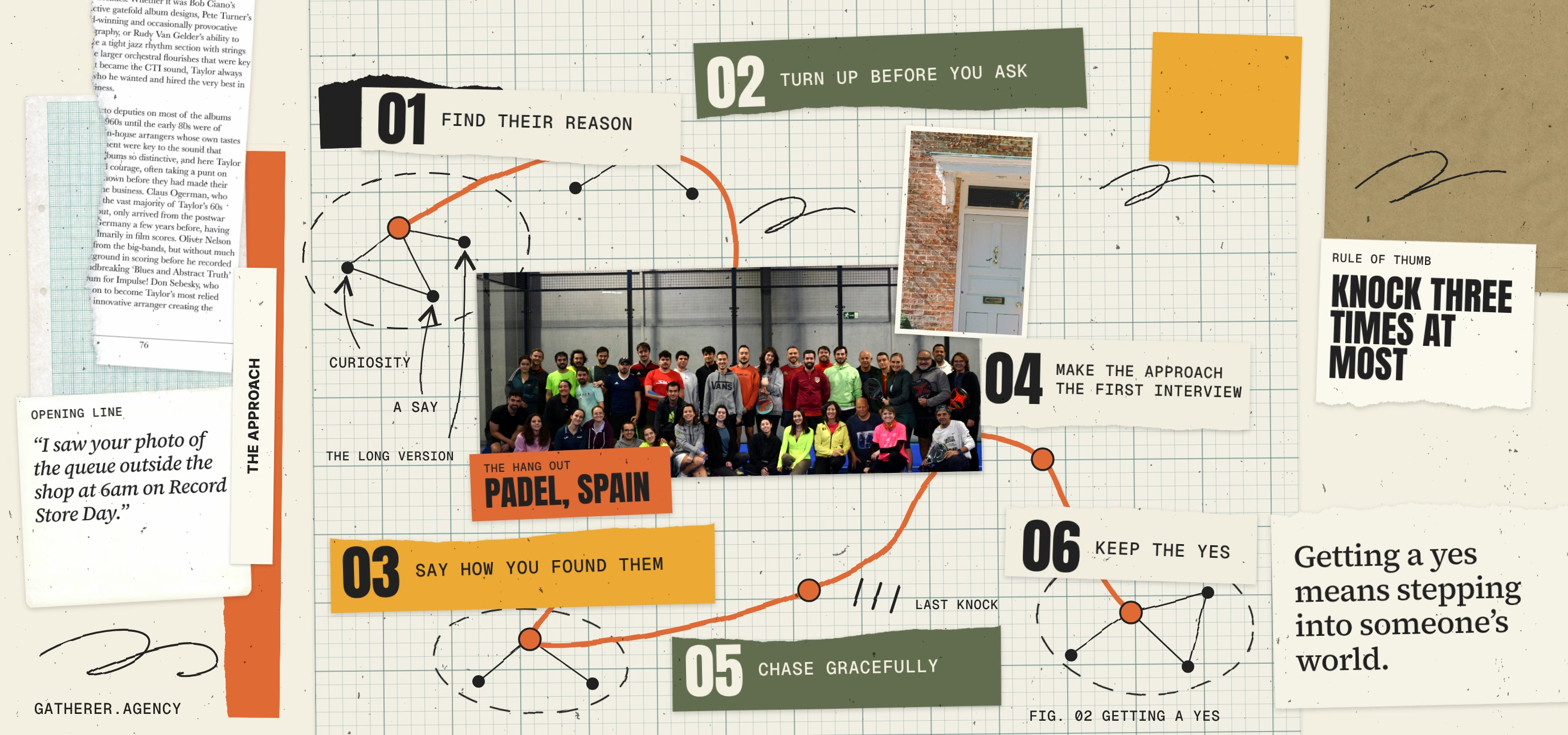
Inboxes are full and call logs read “Suspected Spam”. So how do you get a yes? In part two of the Gatherer method, we explore the approach: finding their reason, turning up before you ask, and saying how you found them.
Next insight
The Method 1/7 - Finding the Right People
Your research is only as good as the people you speak to. So how do you find them? In the first of our series on the Gatherer method, we explore the search itself: mapping networks, following clues, getting out into the field, and knowing when you’ve heard enough.
Next insight
Research as a creative advantage
Working as Polar’s qualitative insight partner, Gatherer brings first-hand evidence into new-business and live creative briefs. Across travel, yachting, sport, workwear, powersports, and beyond, our research has revealed new commercial opportunities, strengthened strategic thinking, and provided the insights behind big branding and creative ideas.

What are
you curious
about?
Tell us what you’re trying to understand, the decision you’re facing, or whose world you need to get closer to. We’ll take it from there.